


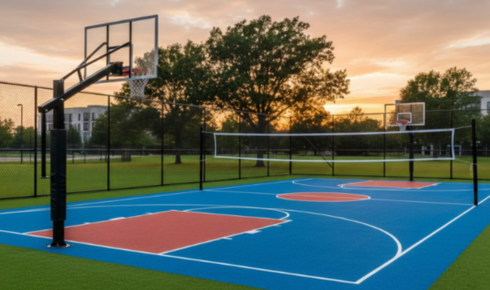
As schools, residential complexes, clubs, and public sports facilities look to maximize space and budgets, the demand for multipurpose courts continues to rise. A well-designed multipurpose court allows multiple sports—such as basketball, tennis, badminton, volleyball, and recreational games—to be played on a single surface without compromising safety or performance.
This guest post breaks down everything first-time planners and decision-makers need to know about multipurpose court construction, including design considerations, cost factors, and the importance of choosing the right multipurpose court flooring. It also reflects industry best practices followed by brands like Topflooring, known for reliable synthetic sports court flooring solutions.
What Is a Multipurpose Court?
A multipurpose court is a versatile sports surface designed to accommodate multiple games on the same playing area. Instead of building separate courts for each sport, facilities can use one surface with customized line markings and adaptable equipment.
This approach is especially popular in:
- Schools and colleges
- Residential societies
- Community parks
- Sports academies
- Recreational clubs
The success of a multipurpose court depends heavily on smart design and the right flooring system.
Key Design Considerations in Multipurpose Court Construction
Court Layout and Dimensions
Designing a multipurpose court requires careful planning to ensure all sports can be played comfortably. Court dimensions are usually based on the primary sport, with secondary sport markings added strategically to avoid confusion.
Clear, durable line markings in different colors help distinguish between sports while maintaining a clean and professional look.
Surface Performance Balance
Different sports demand different surface characteristics. Basketball requires controlled bounce, tennis needs consistent ball response, and badminton benefits from good grip and player comfort.
A well-planned multipurpose court design balances:
- Ball bounce consistency
- Player traction
- Shock absorption
- Surface speed
This balance is achieved primarily through advanced multipurpose court flooring systems.
The Role of Flooring in Multipurpose Courts
Flooring is the most critical element of any multipurpose court. It directly affects gameplay, safety, durability, and maintenance requirements.
Why Synthetic Sports Court Flooring Is Preferred
Modern synthetic sports court flooring systems are widely used in multipurpose court construction because they offer:
- Seamless and joint-free surfaces
- High durability under multi-sport use
- Low maintenance requirements
- Excellent weather and UV resistance
Synthetic flooring systems, especially acrylic-based solutions, are designed to perform consistently across multiple sports, making them ideal for shared-use courts.
Easy Maintenance and Long-Term Performance
One of the biggest advantages of synthetic multipurpose court flooring is ease of maintenance. Regular sweeping and occasional washing are usually enough to keep the surface in good condition.
Over time, only the top coating layers need resurfacing, which is far more cost-effective than replacing the entire court.
Multipurpose Court Construction Cost: What Influences the Budget?
Understanding multipurpose court construction cost helps planners make informed decisions. Costs can vary depending on several factors, including:
- Site preparation and base work
- Choice of flooring system
- Court size and number of sports included
- Drainage and slope requirements
- Indoor vs outdoor installation
While synthetic sports court flooring may involve a higher initial investment than basic surfaces, it significantly reduces long-term maintenance and repair expenses, offering better overall value.
Base Preparation: The Foundation of a Durable Court
No matter how advanced the flooring system is, a weak base can lead to surface issues. Proper base preparation is essential in multipurpose court construction.
A strong base ensures:
- Uniform surface performance
- Proper water drainage for outdoor courts
- Reduced cracking and surface damage
Concrete and asphalt are the most commonly used bases for multipurpose courts due to their strength and longevity.
Indoor vs Outdoor Multipurpose Courts
Outdoor Courts
Outdoor multipurpose courts require flooring that can withstand sunlight, rain, and temperature changes. UV-resistant and weatherproof synthetic systems are ideal for such conditions.
Indoor Courts
Indoor multipurpose courts focus more on aesthetics, controlled play, and player comfort. Synthetic sports court flooring provides a clean finish, consistent performance, and minimal dust—perfect for enclosed spaces.
Safety and Player Comfort
Player safety is a key priority in any sports facility. High-quality multipurpose court flooring systems are designed to:
- Reduce slip risks
- Minimize joint impact
- Support fast directional movement
This makes the court suitable for players of different age groups and skill levels.
Importance of Professional Installation
Even the best materials can fail if installed incorrectly. Professional installation ensures:
- Correct layer thickness
- Uniform texture and finish
- Long-lasting surface performance
Trusted suppliers and material experts like Topflooring focus on precision and quality to ensure that multipurpose courts remain durable and easy to maintain.
Sustainability and Smart Facility Management
Modern synthetic flooring systems support sustainable construction practices. Their long lifespan, low maintenance needs, and reduced use of harsh cleaning chemicals contribute to environmentally responsible facility management.
Final Thoughts
Multipurpose court construction is a smart solution for facilities looking to maximize space, functionality, and budget efficiency. With thoughtful design, controlled multipurpose court construction cost, and high-quality synthetic sports court flooring, a single court can serve multiple sports for years with minimal maintenance.
By investing in durable multipurpose court flooring and following professional construction practices, facility owners can create safe, versatile, and future-ready sports spaces. Supported by reliable industry solutions from Topflooring, multipurpose courts are redefining how modern sports infrastructure is built and maintained.