Finding the Right Water Filter for the Way You Actually Live
Water treatment used to feel like something only a few homeowners thought about. These days, that’s changing. People are paying more attention to what’s coming from their taps, how their water tastes, and whether the equipment in their homes is quietly dealing with years of mineral buildup.
The funny thing is, there isn’t one perfect answer for everyone. A large family may need a completely different setup from someone living in a small apartment. A busy office has different priorities again. And if you’re renting, drilling into plumbing probably isn’t high on your list of weekend hobbies.
The good news? Water treatment has become flexible. There are simple countertop options, point-of-use filters, and convenient dispensers that can fit into all sorts of homes and workplaces.
Start by Understanding Your Water
Before choosing a filter, take a moment to consider what you’re trying to fix.
Is the water tasting strongly of chlorine? Are there visible particles? Do you have hard water that leaves white deposits on faucets? Are you mainly concerned about drinking water, or do you want treatment throughout the entire house?
A water test can help answer questions that appearance alone can’t. Clear water isn’t necessarily free from dissolved minerals or other substances, while cloudy water doesn’t automatically mean something dangerous is present.
If a provider offers a free water test, it can be a convenient way to learn more before spending money on equipment. Just make sure you understand what the test actually checks and what the results mean.
Testing first is usually cheaper than buying the wrong filter and discovering later that it doesn’t address your main concern.
Bottleless Dispensers Make Drinking Water Convenient
For offices, waiting rooms, gyms, schools, and busy households, convenience matters almost as much as filtration.
Bottleless water coolers/dispensers connect directly to a water supply and typically use filtration to provide drinking water without relying on large plastic bottles.
There’s a practical appeal here. No heavy bottles need to be lifted onto the machine. There’s no stack of containers taking up storage space, and businesses don’t have to worry about running out of bottled water unexpectedly.
Many dispensers offer chilled and room-temperature water, while some models include hot-water options.
Of course, they still need regular filter changes and cleaning. Bottleless doesn’t mean maintenance-free. But for high-use environments, the convenience can be significant.
Countertop Filtration for Smaller Spaces
Not every home needs a whole-house water treatment system.
If you’re living in an apartment, renting a property, or simply want better drinking water at the kitchen counter, a smaller system may make more sense.
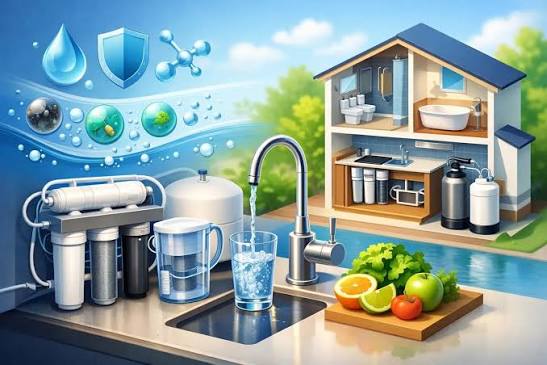
Countertop water filtration offers a relatively simple way to treat water at the point where you use it most. Depending on the technology, countertop units may reduce sediment, chlorine, certain odors, or other substances the filter is specifically designed to address.
They’re also convenient for people who don’t want permanent plumbing modifications.
But there are limitations. A countertop filter generally treats only the water that passes through it. If hard water is affecting your shower, laundry, and water heater, a small kitchen filter won’t solve those issues.
That’s not a flaw. It’s simply a matter of choosing the right tool for the job.
Don’t Assume More Filtration Is Always Better
It’s easy to fall into the “more stages must mean better water” trap.
Marketing materials often list long collections of filtration stages, technical terms, and impressive-sounding features. But the number of stages isn’t what matters most.
What matters is whether the system is designed to reduce the specific substances you’re concerned about.
For example, activated carbon is commonly used for certain taste and odor concerns. Sediment filters can help capture particles. Reverse osmosis can reduce many dissolved substances, depending on the system.
If your primary issue is hard water, though, you may need a softener rather than a standard drinking-water filter.
Understanding the difference can save both money and frustration.
Think About How Much Water You Actually Use
Water consumption should also influence your choice.
A couple living in a small apartment may have completely different needs from a family of six. A busy office might go through several gallons of drinking water every day.
Filter capacity and flow rate matter because an undersized system may become inconvenient or require frequent replacement.
When comparing equipment, look beyond the purchase price. Check the replacement filter cost, expected service life, installation requirements, and ongoing maintenance.
Sometimes the cheapest filter isn’t the cheapest option over five years.
Taste Is Important, But It Isn’t Everything
Taste is often what motivates people to buy a filter, and that’s perfectly reasonable. If water tastes unpleasant, you’re less likely to drink it.
Still, taste alone doesn’t tell you whether water is safe or unsafe.
Some contaminants have no noticeable taste or smell. That’s another reason testing can be useful, especially for private well owners.
If you’re concerned about a specific contaminant, look for a filter that has been independently tested or certified for reducing that particular substance. Don’t rely solely on vague claims such as “purifies everything.”
A little skepticism is healthy when shopping for water treatment equipment.
Maintenance Is the Part Nobody Likes
Whatever system you choose, remember that filters don’t last forever.
A cartridge that’s designed to treat a certain volume of water will eventually reach its capacity. Leaving it in place indefinitely can reduce performance and may affect water quality.
Mark the replacement date on the filter housing or put a reminder on your phone. For bottleless dispensers, keep up with cleaning and servicing. For countertop systems, follow the manufacturer’s replacement schedule.
It takes only a few minutes to stay organized, and it prevents the classic problem of realizing six months later that the filter should have been changed months ago.
Choose the System That Fits Your Routine
The best water treatment system is the one you’ll actually use and maintain.
For high-use offices and commercial spaces, bottleless dispensers can provide convenient filtered drinking water without the hassle of large bottles. For smaller homes or rentals, countertop filtration may be all that’s needed.
Whatever you choose, start by understanding your water and your goals. Test when appropriate, compare what each system is designed to remove, and consider long-term maintenance costs.
Good water treatment doesn’t need to be complicated. It just needs to make sense for your home, your water, and the way you live.